What Is an RC Car? A Simple Beginner’s Guide
If you are new to the RC car hobby, it can feel like there is a lot to figure out at first.
You might see people driving tiny cars at high speed, crawling over rocks, racing around dirt tracks, or tuning nitro engines that sound like miniature race cars.
So what exactly is an RC car?
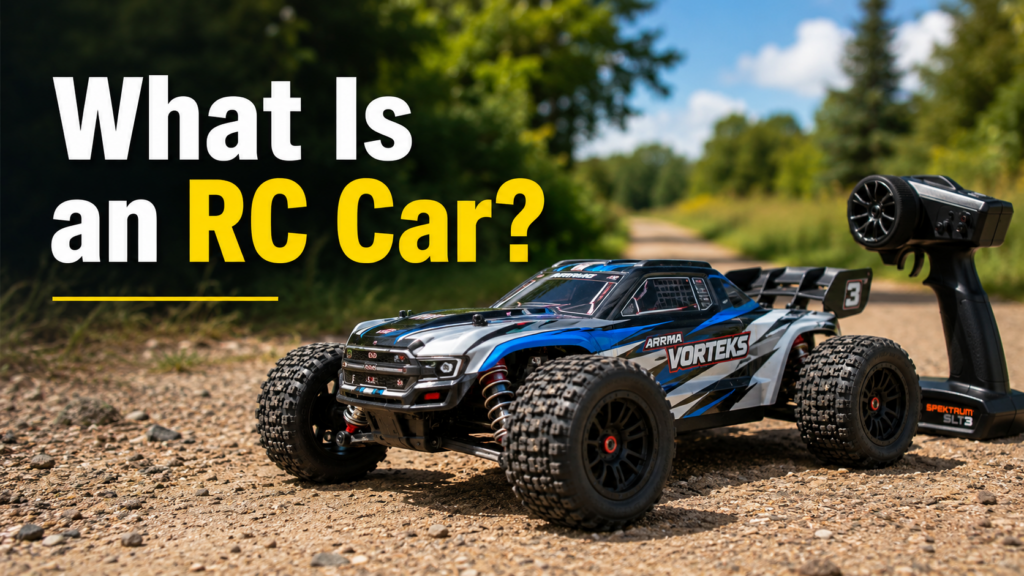
An RC car is a small vehicle controlled from a distance using a handheld radio transmitter. RC usually means radio-controlled. Some people also say remote-controlled, but in the hobby world, radio-controlled is the more accurate term.
RC cars can be simple toys, but hobby-grade RC cars are different. They are faster, stronger, repairable, upgradeable, and built for people who want more than just a basic toy car.
In this guide, we’ll keep things simple and explain what RC cars are, how they work, the main types, and what beginners should know before buying one.
What Does RC Car Mean?
RC stands for radio-controlled.
That means the car receives signals from a radio transmitter. When you pull the trigger, turn the steering wheel, or press a control on the transmitter, the car responds.
A basic RC setup includes:
- The RC car
- A handheld transmitter
- A receiver inside the car
- A motor or engine
- A battery or fuel system
- A steering servo
- Speed control or throttle system
In simple terms, you hold the controller, send commands, and the car follows those commands.
Is an RC Car the Same as a Toy Car?
Not always.
There are two main categories:
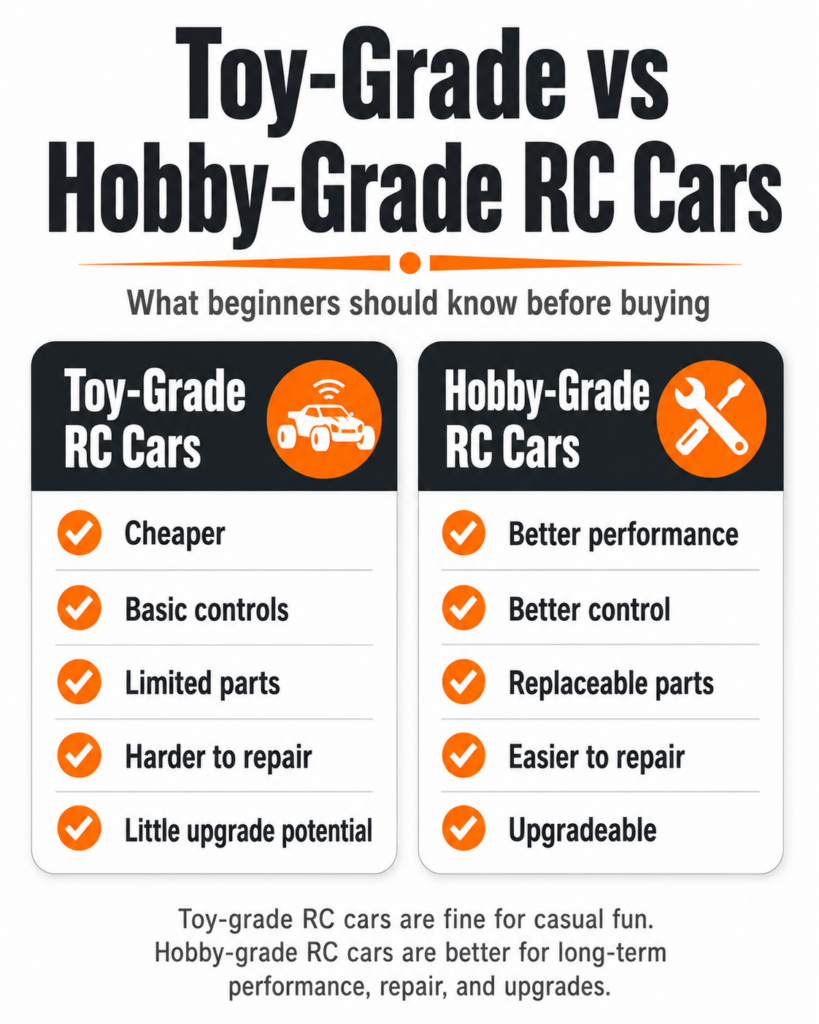
- Toy-grade RC cars
- Hobby-grade RC cars
Toy-grade RC cars
Toy-grade RC cars are usually cheaper and simpler. You might find them at big box stores, toy aisles, or gift shops.
They are fine for casual fun, especially for younger kids, but they usually have limits.
Common toy-grade RC car features:
- Lower speed
- Basic controls
- Limited battery life
- Fewer replacement parts
- Little or no upgrade options
- Not built for serious driving
If something breaks, many toy-grade cars are hard to repair.
Hobby-grade RC cars
Hobby-grade RC cars are made for people who want a real hobby experience.
They are usually faster, tougher, and easier to repair. You can replace broken parts, upgrade components, change tires, improve batteries, and customize the car over time.
Common hobby-grade RC car features:
- Better speed and control
- Replaceable parts
- Upgrade options
- Stronger suspension
- Better tires
- More powerful motors
- Longer-lasting platforms
- More realistic driving
If you are an adult getting into RC cars, you probably want a hobby-grade RC car.
It may cost more upfront, but it gives you a much better experience.
How Does an RC Car Work?
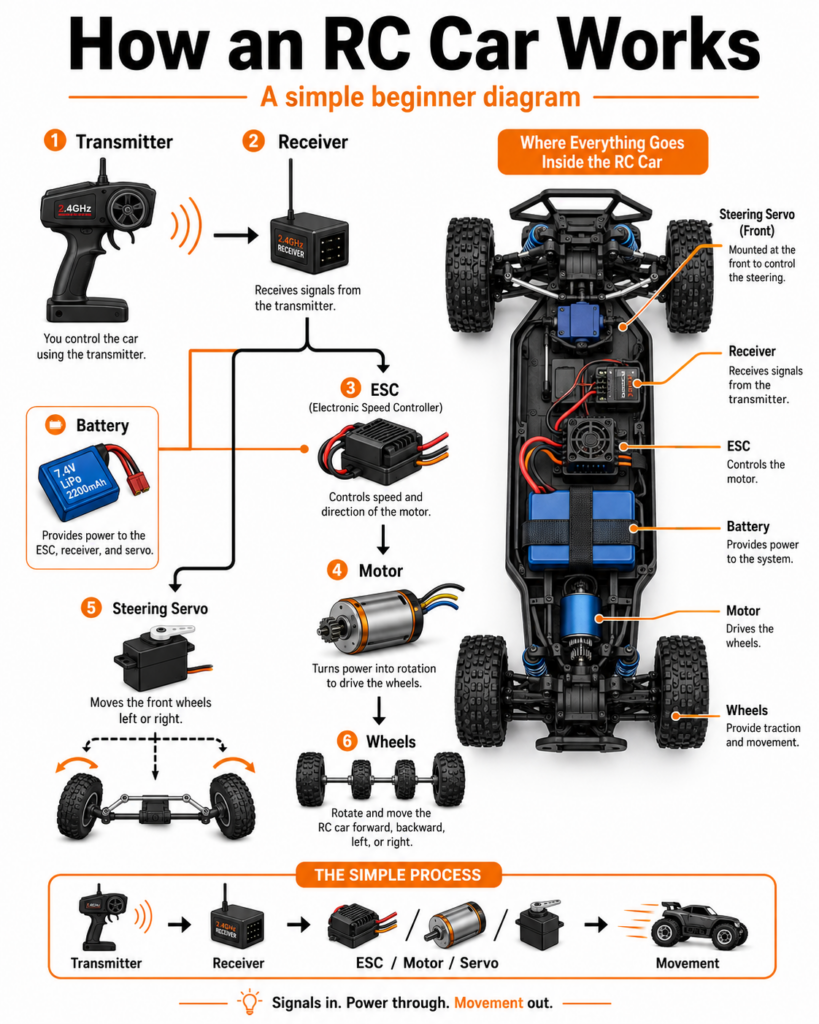
An RC car works by combining radio control, power, steering, and motion.
Here is the simple version.
You use the transmitter to control the car. The receiver inside the car picks up the signal. The car then uses that signal to control steering and speed.
Steering
Most hobby-grade RC cars use a small part called a servo to steer the front wheels.
When you turn the wheel on the transmitter, the servo moves the steering system left or right.
Throttle
When you pull the trigger on the transmitter, the car moves forward.
On an electric RC car, the throttle signal goes through an electronic speed controller, often called an ESC. The ESC tells the motor how much power to use.
On a nitro RC car, the throttle opens and closes the carburetor to control engine speed.
Power
RC cars usually get power in one of two ways:
- Electric battery
- Nitro fuel engine
Electric RC cars are the most common choice for beginners because they are easier to use and maintain.
Electric RC Cars
Electric RC cars use a battery-powered motor.
You charge the battery, plug it into the car, turn everything on, and drive.
That is why electric RC cars are usually the best starting point for beginners.
Why beginners like electric RC cars
Electric RC cars are:
- Easier to start
- Cleaner
- Quieter
- Easier to maintain
- Better for neighborhoods
- More beginner-friendly
They can still be very fast. Some electric RC cars are extremely powerful, especially brushless models using LiPo batteries.
Main electric RC car parts
An electric RC car usually has:
- Battery pack
- Motor
- Electronic speed controller
- Receiver
- Steering servo
- Drivetrain
- Suspension
- Tires and wheels
You do not need to understand every part on day one. But it helps to know the basics.
Nitro RC Cars
Nitro RC cars use small fuel-powered engines.
They run on nitro fuel, which is a special model engine fuel. Nitro RC cars are louder, more realistic, and more mechanical than electric cars.
Some hobbyists love nitro because it feels more like working with a real engine.
Why people like nitro RC cars
Nitro RC cars are:
- Louder
- More realistic
- More mechanical
- Fun for people who like tuning engines
- Great for hands-on hobbyists
But they are not always the easiest first choice.
Why nitro can be harder for beginners
Nitro RC cars require more setup and maintenance.
You may need to learn about:
- Glow plugs
- Fuel
- Carburetor tuning
- Air filter cleaning
- Engine break-in
- After-run care
- Idle adjustment
Nitro is fun, but it rewards patience.
If you want to drive with less frustration, start with electric. If you enjoy engines and tinkering, nitro may be worth considering later.
Main Types of RC Cars
RC cars come in many styles. The best one for you depends on where you want to drive.
RC trucks
RC trucks are one of the best choices for beginners.
They usually have more ground clearance and bigger tires than road cars. That makes them better for grass, dirt, gravel, and backyard driving.
Good for:
- Beginners
- Backyards
- Dirt
- Gravel
- Parks
- Bashing
RC buggies
RC buggies are sporty, lightweight, and fun to drive.
They usually handle well on dirt, packed surfaces, and tracks. They are not always the best choice for tall grass, but they are great if you want something quick and responsive.
Good for:
- Dirt tracks
- Packed dirt
- Parking lots
- Learning control
- Sporty driving
RC monster trucks
Monster trucks are tough-looking RC vehicles with big tires and higher ground clearance.
They are great for beginners who want to drive over rougher surfaces and have fun without being too serious.
Good for:
- Grass
- Dirt
- Backyard driving
- Jumps
- Casual fun
RC short course trucks
Short course trucks look like small off-road race trucks.
They are popular because they are stable, fun, and versatile. A model like a Traxxas Slash-style truck is often a strong beginner choice.
Good for:
- Dirt
- Pavement
- Parking lots
- Backyard driving
- Beginner racing
RC crawlers
RC crawlers are slow, controlled vehicles built for climbing rocks, trails, and obstacles.
They are not about speed. They are about control and realistic driving.
Good for:
- Rocks
- Trails
- Technical driving
- Scale realism
- Relaxed driving
RC drift cars
RC drift cars are made to slide around corners on smooth surfaces.
They are fun, but they are more specialized. They are usually not the best first RC car unless drifting is the main thing you want to do.
Good for:
- Smooth pavement
- Indoor tracks
- Drift practice
- Car-style customization
RC touring cars
Touring cars are low, fast, and made for smooth pavement.
They are great for on-road racing, but not good for grass, rocks, or rough driveways.
Good for:
- Pavement
- Parking lots
- On-road racing
- Scale car fans
What Is a Hobby-Grade RC Car?
A hobby-grade RC car is built to be maintained, repaired, and upgraded.
That is the big difference.
With a hobby-grade RC car, you can usually replace parts like:
- Tires
- Wheels
- Suspension arms
- Shocks
- Motors
- Batteries
- Body shells
- Gears
- Steering parts
- Electronics
This is what makes the hobby fun. You can start simple, then upgrade as you learn.
A good hobby-grade RC car does not become useless after one crash. You fix it, learn from it, and keep driving.
What Is an RTR RC Car?
RTR stands for ready-to-run.
An RTR RC car comes mostly assembled from the factory. For beginners, this is usually the easiest way to get started.
Depending on the model, you may still need to:
- Charge the battery
- Install transmitter batteries
- Check screws
- Read the manual
- Install the body
- Bind the transmitter, if needed
But overall, RTR cars are made to get you driving quickly.
RTR is best if you want:
- Less setup
- Faster start
- Fewer decisions
- A simpler first experience
For most beginners, RTR is the way to go.
What Is an RC Kit?
An RC kit is a car you build yourself.
Some kits include many parts, but not everything. You may need to buy electronics, radio gear, battery, charger, paint, or tools separately.
Kits are great for people who enjoy building.
Kits are best if you want:
- A hands-on project
- To learn how the car works
- More control over parts
- A deeper hobby experience
If your goal is to drive today, get an RTR.
If your goal is to build and learn, a kit can be a lot of fun.
What Scale Are RC Cars?
RC cars come in different sizes called scales.
Scale compares the RC car to a real vehicle.
For example, a 1/10 scale RC car is roughly one-tenth the size of a real vehicle.
Common RC car scales include:
| Scale | What It Means |
|---|---|
| 1/24 | Very small, good for indoor driving |
| 1/18 | Small, portable, good for tight spaces |
| 1/16 | Compact but still fun outdoors |
| 1/10 | Most common hobby size |
| 1/8 | Larger, faster, more serious |
| 1/5 | Very large and expensive |
For beginners, 1/10 scale is usually the best starting point.
It is big enough to handle outdoor driving, but not so large that it becomes hard to store, carry, or maintain.
How Fast Do RC Cars Go?
RC car speed depends on the model, motor, battery, gearing, and surface.
Beginner RC cars may run around 15 to 30 mph.
Faster hobby-grade RC cars can go 40, 50, 60 mph or more.
But speed is not everything.
For beginners, control matters more than top speed. A very fast RC car can be harder to drive and easier to crash.
A tough RC car that goes 25 mph may be more fun than a fragile car that goes 60 mph and breaks every time you make a mistake.
How Much Do RC Cars Cost?
RC cars vary a lot in price.
Here is a simple beginner budget range:
| Budget | What to Expect |
|---|---|
| Under $100 | Mostly toy-grade or very small RC cars |
| $150 to $250 | Entry-level hobby-grade options |
| $250 to $400 | Strong beginner hobby-grade choices |
| $400 to $700 | Faster, tougher, more advanced RC cars |
| $700+ | Serious hobby, racing, large-scale, or premium models |
For most adults getting into the hobby, a good first setup usually costs around $250 to $400 once you include the car, battery, charger, and basic tools.
Remember, the car is not the only thing you may need.
What Do You Need With Your First RC Car?
Before buying your first RC car, check what is included.
Some RC cars include everything. Others do not.
You may need:
- Battery
- Charger
- AA batteries for transmitter
- Basic tool kit
- Extra battery
- Spare body clips
- LiPo safety bag
- Cleaning brush
- Small parts tray
An extra battery is one of the best first purchases. It lets you drive longer instead of waiting for your only battery to recharge.
A better charger is also worth considering if the included charger is slow or basic.
Where Can You Drive an RC Car?
Where you drive depends on the type of RC car.
Good places include:
- Driveways
- Parking lots
- Backyards
- Dirt lots
- Parks
- RC tracks
- Trails
- Garages
- Basements
- Rock gardens
Before driving, make sure RC cars are allowed in the area. Be respectful around people, pets, cars, and property.
If you are driving in a neighborhood, electric RC cars are usually better because they are quieter than nitro models.
Are RC Cars Hard to Maintain?
Not usually, but they do need some care.
Basic RC car maintenance includes:
- Cleaning dirt and dust after driving
- Checking screws
- Looking for broken parts
- Checking tires
- Inspecting wires
- Charging and storing batteries safely
- Keeping the drivetrain clean
- Cleaning air filters on nitro cars
Electric RC cars are easier to maintain than nitro RC cars.
For beginners, the most important habit is simple: check the car before and after driving.
A few minutes of maintenance can prevent bigger problems later.
Are RC Cars Good for Adults?
Yes. RC cars are a great hobby for adults.
They combine speed, mechanics, driving skill, customization, and outdoor fun. You can keep it casual, or you can go deep into racing, tuning, building, and upgrading.
RC cars are especially good for adults who enjoy:
- Cars
- Tools
- Electronics
- Motors
- Racing
- DIY projects
- Outdoor hobbies
- Weekend projects
- Parent-child hobbies
You do not have to be an expert to start. You just need a good beginner vehicle and a little patience.
Best Type of RC Car for Beginners
For most beginners, the best first RC car is an electric RTR truck.
That usually gives you the best mix of:
- Easy setup
- Durability
- Ground clearance
- Parts support
- Simple maintenance
- Fun driving
If you are buying your first RC car as an adult, start with something practical.
Good beginner choices include:
- Electric short course truck
- Electric monster truck
- Electric buggy
- Small-scale electric truck
- Beginner-friendly crawler
Avoid starting with something too fast, too expensive, or too specialized unless you already know exactly what you want.
Common Beginner Mistakes
Buying only based on speed
Fast is fun, but it is not everything. Durability and parts support matter more for your first RC car.
Forgetting the battery and charger
Some RC cars do not include a battery or charger. Always check before buying.
Driving in the wrong place
A low on-road car will not be fun in grass. A rock crawler will not be exciting in a wide-open parking lot. Match the car to where you plan to drive.
Buying too cheap
A cheap RC car may seem like a good deal, but if replacement parts are not available, one broken part can end the fun.
Skipping the manual
Read the manual before driving. It can save you from simple mistakes.
Ignoring maintenance
Even simple electric RC cars need cleaning and inspection.
Quick Beginner RC Car Checklist
Before buying your first RC car, ask yourself:
- Where will I drive it?
- Do I want speed, crawling, drifting, or backyard fun?
- Do I want electric or nitro?
- Do I want RTR or a kit?
- Are replacement parts easy to find?
- Does it include a battery and charger?
- What extra accessories do I need?
- Is it beginner-friendly?
- Can I repair it if something breaks?
If you can answer those questions, you are already ahead of most beginners.
Final Thoughts
An RC car is more than a small vehicle with a remote.
A good hobby-grade RC car can be a fun weekend hobby, a hands-on project, a way to learn mechanics, or something to enjoy with your kids, friends, or local RC community.
If you are just starting out, keep it simple.
Choose an electric RTR model, make sure parts are available, buy the basic accessories, and learn as you go.
You do not need the fastest or most expensive RC car to have fun. You just need one that fits where you drive and how you want to enjoy the hobby.
Once you get started, you can always upgrade later.